





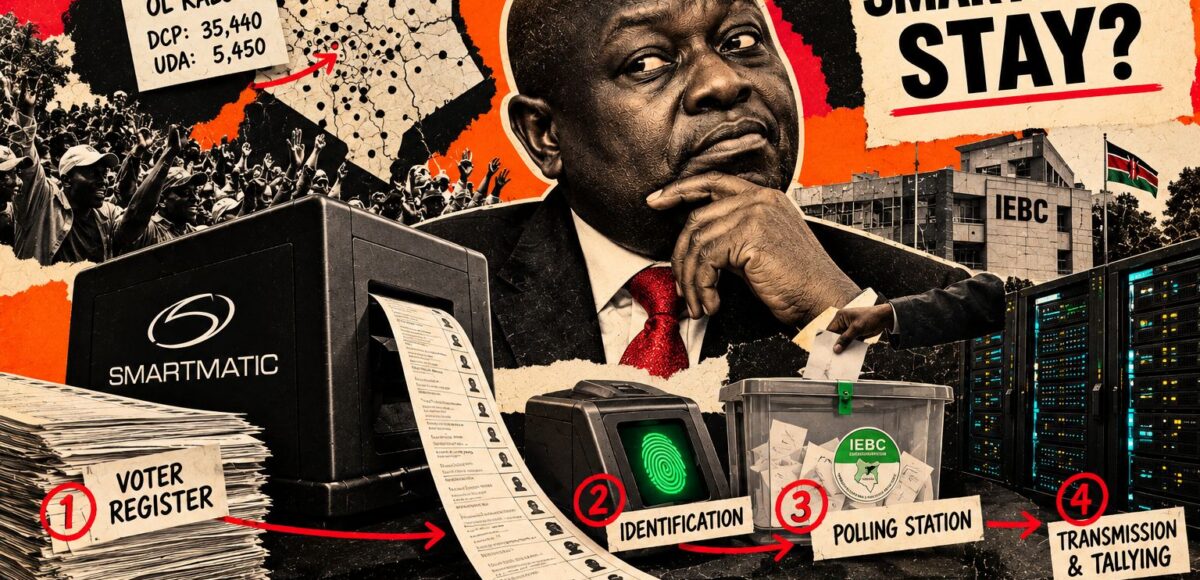
Rigathi Gachagua wants Smartmatic to stay. I find that very interesting.
Not because there is anything inherently sinister about wanting continuity in election technology. Rigathi’s public argument is actually perfectly sensible. We are less than a year from an election, Smartmatic already knows the Kenyan system, the data already exists, migration creates risk, and bringing in an entirely new provider this late could create more problems than it solves. He says he has seen the system work and thinks it is “quite okay.”
Fine.
But there is another way to read it. Call it a hypothesis. Call it a conspiracy theory if you like. If there was any monkey business in 2022 on the UDA side, Rigathi Gachagua is one of the people I would expect to know something about it. Not necessarily everything. Not the Venezuelans sitting somewhere typing furiously into a computer. I mean the practical mechanics of an election on the ground: how you organise people, how you protect or maximise your vote, where systems bend, where human discretion enters, where the gaps are.
And I think I know why Rigathi would know that part.
Rigathi is an old provincial administration man. Before the suits and the politics, he was a District Officer in the Office of the President. He underwent paramilitary training at the Administration Police Institute, studied advanced public administration and spent years inside the old machinery of government. By 2022, Ruto was describing him as a “fantastic grassroots mobilizer,” and that was really the value proposition of Rigathi Gachagua. He understood the Mountain, but more importantly, he understood the ground.
UDA’s 2022 campaign itself tells you something about how seriously that ground operation was taken. One of its strategies in Mt Kenya was literally called “adopt a polling station”: recruit people around polling stations, mobilise supporters and have people remain there to protect the vote. This was not a campaign that believed elections were won only on television.
Which brings us back to Smartmatic.
In order to explain why Rigathi wants Smartmatic to stay, first I need to break down how an election using a system like Smartmatic could theoretically be manipulated.
There are four main vulnerabilities, each appearing at a different stage of the electoral process, from before you cast your vote all the way to the national tallying centre.
The first is the voter register. Before election day even arrives, somebody has already determined who is registered, where they are registered and therefore who can vote where. If that register is compromised through duplicates, dead voters, fictitious entries or wrongful removals, the problem is already inside the election before anybody reaches a polling station.
The second is identification. You arrive at the polling station and the system has to recognise you. Biometrics, identification devices and the procedures used when they fail create another vulnerability. Who gets accepted? Who gets rejected? What happens when the machine cannot identify someone? At this stage, the technology begins interacting with officials, agents and procedure.
The third is the polling station itself. This is probably the most human part of the system. Presiding officers, party agents, forms, objections, assisted voting, failed identification and all the little decisions that have to be made over the course of the day. A party with well-trained agents who understand exactly how the system works has an obvious advantage here.
And then there is the fourth vulnerability: transmission and tallying. Once the votes have been counted, the result has to travel from the polling station to the constituency and ultimately to the national tally. This is the stage that normally attracts the conspiracy theories because people imagine servers being hacked and figures being changed somewhere in Nairobi.
But that is not actually the part that interests me most.
If Rigathi knows how to squeeze an advantage out of Smartmatic, I suspect it is much further down the chain. Somewhere around vulnerabilities two and three, where the technology meets the polling station, the officials and the agents. That is the terrain he understands. His value has never been technological. It has always been organisational. He understands the ground. He understands agents. He understands local administration. He understands how to mobilise people and how to turn political support into an actual vote that makes it through the system.
So if there was any mischief in 2022, and again, this is only a hypothesis, the part Rigathi would be most likely to understand is not some grand server conspiracy. It is the ground-level mechanics. The places where the register, the machine, the official and the agent all meet. Which is why I find his defence of Smartmatic so interesting.
Which brings me to Ol Kalou.
Before that by-election, Rigathi was extraordinarily territorial. He told even his own opposition counterparts to stay away. His argument was that Ol Kalou was a local contest and DCP had already done the work on the ground. He simultaneously raised the alarm about the state, IEBC, police and alleged interference around the election.
Then DCP absolutely destroyed UDA. Sammy Kamau won 35,440 votes against UDA’s 5,450.
A few weeks later, Rigathi is telling us that Smartmatic should stay.
Again, none of this proves anything. It may prove absolutely nothing. But it makes the question more interesting.
Because if Rigathi now commands the largest concentrated voting bloc available to the opposition, his problem is no longer merely winning people’s support. It is converting that support into its maximum possible electoral value. Getting people registered. Getting them to the correct polling station. Getting them through identification. Having agents everywhere. Understanding every procedure. Protecting every vote. Knowing the technology and knowing the human beings operating around it. If you already understand the terrain, why would you voluntarily change the terrain?
This is where Rigathi suddenly parts company with his opposition colleagues. Kalonzo, Muturi and Wamalwa want Smartmatic gone. Kalonzo has gone as far as saying IEBC must “completely sever all ties” with the company.
Their logic is also easy to understand. They went into 2022 believing something had gone seriously wrong with the electoral system. Smartmatic became entangled in that suspicion. The Venezuelans arrested shortly before the election became one of its most bizarre symbols. Kalonzo and company have simply taken the next political step: if you believe the old machinery carries unresolved risk, remove the machinery.
Rigathi has reached the opposite conclusion. And that is the bit I cannot get past.
Perhaps he is simply being practical. In fact, there is a serious argument that changing election technology eleven months before a general election is reckless. A rushed procurement, rushed migration, rushed testing and a completely new vendor could create exactly the vulnerabilities the opposition claims it wants to prevent. On that narrow technical point, Rigathi may well be right.
But politics is about incentives, and Rigathi’s incentive is worth interrogating.
If there was any mischief in 2022, and I stress if, Rigathi would not need to know how the entire election was supposedly engineered. He would only need to have learned something much more valuable: how the machine works where politics actually happens.
On the ground.
And if you have spent your life mastering the ground, if you have already fought one presidential election using that system, if you have just demonstrated in Ol Kalou that you can organise an astonishingly efficient electoral machine, and if you are now sitting on perhaps the most valuable voting bloc in the country, perhaps the last thing you want eleven months before an election is somebody arriving with a new machine and changing all the rules you have spent years learning.
Maybe Rigathi trusts Smartmatic. Or maybe Rigathi trusts what he knows about Smartmatic. Those are two very different things. I’ll leave the rest to your imagination.





No comments